Hi, I'm Sunny. I trained as a computer engineer, started as a data engineer, and have spent six years in go to market turning scattered signals into scored, routed accounts a rep can act on.
Each step below is a system I built for a real team, in the order a lead moves through it. Client names are withheld under NDA, and numbers marked ~ are rounded.
1
Find the market
Everything starts with knowing who is worth selling to, even when no database can tell you.
Series A healthcare AIUS health systems
An ICP no database could find
The ideal customer was defined by net patient revenue, a number no lead database carries, so the target list couldn't be built. I showed that net patient revenue tracks employee count and used headcount as the proxy, which made the market countable and grew it by more than 70%. From there, signal connectors watch every account for leadership changes, M&A and funding, hiring, layoffs and WARN notices, and competitor moves. Three scoring rubrics grade each account, a QA pass checks the grade before any rep sees it, and hot accounts land with the right AE in Slack.
Swipe to see the full flow →
A proxy makes the market countable. Signals and a checked score decide who hears about it today.
70%+larger addressable market
3enterprise meetings with health systems
Every accountQA'd before it reaches a rep
2
Catch the moment
A good list only matters if you know when someone is ready, and what to say to them.
Coaching clientLinkedInMy favourite build
A warm path to women CEOs
A coaching client sold to women CEOs and needed to fill a free webinar on a short timeline. People who like or comment on a competitor's post already know the problem, so that engagement became the signal. I kept decision makers only, and an HTTP column sent each profile photo to an image classification model so only women CEOs went through. After enrichment in Clay, I matched each person's work history against the client's own network, and a shared school or past employer opened every connection request.
Swipe to see the full flow →
Engagement finds people who know the problem. The filter and the warm path decide who is worth a request.
Connection requests~140
Accepted~90
Joined the webinar~40
The client closed new business from that webinar.
Agency clients + a YC AI startupClay
Intent from who is engaging
The same idea runs as a workflow that's always on. Everyone reacting to competitors' posts, target decision makers' posts and our own leadership content is enriched, checked against each client's ICP and routed into a personalized sequence. On a low volume segment it lifted reply rates from 1% to 3.6%, and paired with funding signals it booked the meetings that became two customers for an AI platform backed by YC.
Swipe to see the full flow →
1% → 3.6%reply rate on a low volume segment
$108K ARRtwo customers for an AI platform backed by YC
3
Get it to the right rep
Once an account raises its hand, the right person should know within minutes.
Series A healthcare AIInbound
Every touch, one score, straight to the AE
On the inbound side, leads arrived through eight channels, each living in its own tool, and the team spent more than 70 minutes a day stitching them together by hand. I pulled every source into one model. Each touch carries its own score, scores roll up per lead and per account, and a buyer timeline with a live graph shows where the person and the company engaged. When an account turns hot, the owning AE gets a Slack alert with the owner resolved from Salesforce at that moment, and the daily stitching is gone.
Swipe to see the full flow →
Eight disconnected feeds become one score and one timeline per account.
70+ mina day of manual stitching, now automated
8 sourcesin one buyer timeline
Minutesfrom a hot account to the owning AE
4
Answer every reply
Replies go cold fast, so the first answer shouldn't wait for a human.
Live across agency clientsn8n
A reply agent that books the meeting
Every reply deserves a fast, accurate answer. I built an agent in n8n that reads each reply, answers it, asks qualifying questions and books the meeting. It runs live across multiple clients.
Swipe to see the full flow →
300+replies handled
~14meetings booked in three months
5
Keep the machine clean
None of it works on a messy CRM or a burnt out mailbox.
Series A healthcare AISalesforce
A CRM the team can trust
None of this works on a messy CRM. SDRs and AEs counted a booked meeting differently, former employees were still in Salesforce, exposed API keys had never been rotated, and AEs weren't logging their calls. I set one definition both teams report against, removed former staff, rotated every exposed key, and synced Grain with Salesforce so every call from every AE, SDR and leader is logged with its opportunity opened.
BeforeAfter
Meeting bookedTwo definitions, SDRs vs AEsOne definition for both teams
Former staffFormer employees still in the CRMRemoved
API keysExposed and never rotatedRotated
Sales callsOften not loggedLogged from every calendar, with the opportunity opened
LeadosaurusSending infrastructure
10,000 mailboxes that look after themselves
Outbound only works if the mail lands. Across 10,000 mailboxes, a monitor in Airtable watches reply rates, a drop triggers an automatic swap, and every sending domain is checked against blacklists each day. The same order of work rescued an education campaign stuck at a 0.1% reply rate: fix the sending first, then send research emails to marketing and operations staff, then rewrite the outreach in their words.
Swipe to see the full flow →
A closed loop. Problems get caught before a campaign's numbers move.
10Kmailboxes monitored and swapped automatically
0.1% → 3.25%reply rate on the education turnaround
39%of those replies positive
6
Make it cheaper to run
And every month it should cost less to run, not more.
$5K/mo
Software spend found on accounts that were never offboarded, hidden across tools and the CRM. A tool now reports them daily, before they renew.
6,544
Clay credits saved a month. A tool calculates what each table spends and recommends a cheaper structure.
12.33 hrs/wk
Saved by automating lead scoring and routing to strategists, with a daily CRM sync.
40%
Contact coverage, reached by sourcing data beyond Apollo.
Proof
What it looked like on the other side
Unedited screenshots. I've only hidden the prospects' details.
Slack#general
Marty, announcing the close to the whole team
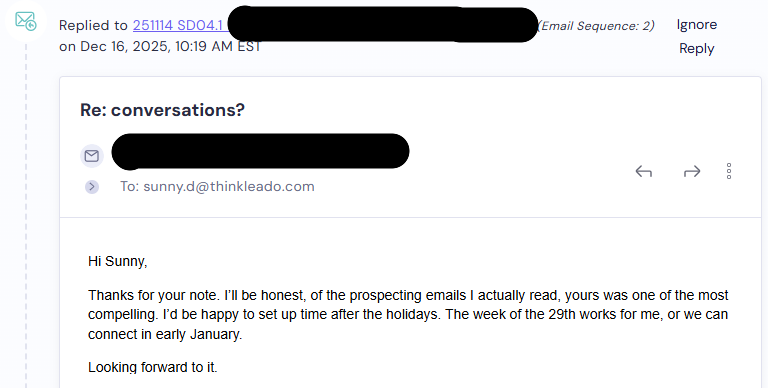
EmailReply to my sequence
A prospect, December 2025. The call was booked for after the holidays.
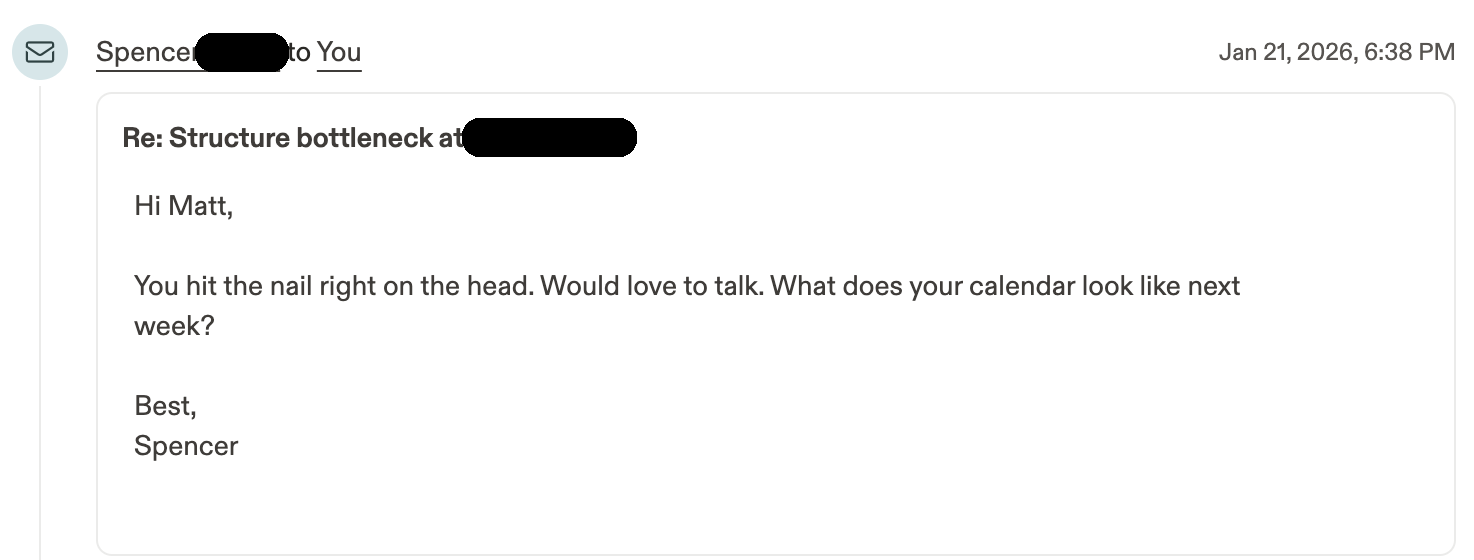
EmailReply to a campaign I wrote
A prospect, January 2026, replying to copy I wrote for a client.
Approach
How I work
First
Learn it by hand
While new inboxes warm up, I reach people myself, one at a time, until I know which offer works. Only then does it become a system.
Always
Ask what changed
One signal is a list. I read what changed at the account and what that change means for the buyer.
Then
Ship, measure, document
Every build ships with a spec, a workflow diagram and a walkthrough, so the team can run it without me.
Background
Computer engineering degree, then data engineering. I've spent six years in GTM: first through my own practice, B2B Dynamics, since 2020, and since March 2025 as a GTM engineer at Leadosaurus, a B2B outbound agency.
Recent work includes a Series A healthcare AI company selling to US health systems and an AI platform backed by YC, for teams across the US, Canada and Germany. My own job search runs on a system I built with Claude Code that scores companies and surfaces the ones worth reaching out to.